
Parrish Cosmetic & Plastic Surgery Center
Medford
701 Golf View Dr.
Medford, OR 97504
Toll Free: 800-458-0684


Breast Enlargement
Augmentation Mammoplasty is an operative procedure in which implants are used to enlarge the breast. Many women desire fuller breasts. Whether it is to enhance their body contour, correct a reduction in breast volume after pregnancy or to balance different breast sizes, many women are choosing Augmentation Mammoplasty.
Both saline and silicone gel implants have been used for approximately 30 years. Saline and gel implants are similar in that they both have shells made of silicone "rubber". However, saline implants are filled with a saltwater solution at the time of surgery, instead of being pre-filled with silicone gel. In 2006, after an in depth evaluation, the FDA approved silicone gel implants and determined them to be safe and effective. Today many women are choosing gel implants because they feel and move much like natural breast tissue.
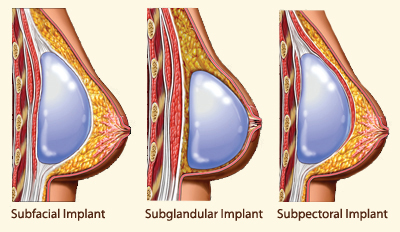
The implants are inserted into the body through an incision in the crease beneath the breast, or around the nipple and areola, or in the armpit. The implants are placed between the breast tissue and chest muscle, or beneath the muscle covering (subfascial), or beneath the breast and chest muscles. The method for inserting and placing the implants depends on the type of implant, the degree of enlargement desired, your body type, and your surgeon's recommendations.
Breast augmentations can be performed at our accredited surgical center. The patient receives either local anesthesia with sedation or general anesthesia during the length of the surgery, which takes approximately two hours. You must arrange for someone to drive you home following surgery and spend the first night and the next day with you. Depending upon your job, Dr. Parrish recommends at least one week off work.
 Now there is a smarter delivery for silicone gel implants using the Keller Funnel. The Keller Funnel is a coneshaped, nylon device that allows a no touch delivery technique. The implant is dropped into the funnel and then gently squeezed through. This technique allows for smaller incisions, faster introduction minimizing scar tissue, and is believed to reduce infection and capsular contracture complications. Dr. Parrish is using the Keller Funnel in all patients receiving gel implants. To to learn more about this technique visit http://kellerfunnel.com/
Breast Lift
Mastopexy is typically performed to lift sagging, loose breasts or breasts that have lost volume and elasticity after child-bearing. It also can reduce the size of the areola, the dark pink skin surrounding the nipple. The extent of this procedure depends on what changes are desired. On occasion, if the patient's original breast size is smaller than she desires, enlargement may be performed at the same time. There are two different surgical techniques for mastopexy:
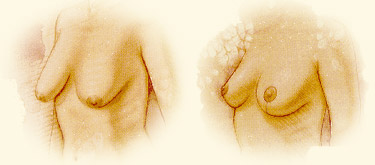
Standard Mastopexy - This method is used when larger skin removal is involved. Incisions are made following the natural contour across the breast and around the nipple. A keyhole-shaped incision is also made above the nipple to define the new location for the nipple. Working through the horizontal incisions, the excess skin from the lower section of the breast is removed. The nipple and underlying breast tissue are moved up to a new, higher position. Flaps of skin formerly above and to the sides of the nipple are brought down around and together to reshape the breast. Sutures close the wound under the breast and around the nipple area. It may also be possible to avoid the incision in the breast crease depending on the amount of skin that needs to be removed.
Binnelli Technique - First, an incision is made around the areola. A circular section of excess skin is then removed. Next, a suture is used to draw the breast skin in (like a purse string), and is then sutured in place to the areola. A permanent suture is left in place below the skin for at least one year. Pleats or puckering resolve approximately six months to one year later.
Mastopexy - These procedures are performed at our accredited surgical center. They may take approximately 3 to 4 hours and are performed under local anesthesia with sedation or a general anesthesia.
Post-operatively, the patient is placed in a supportive, mild compression-type bra. Stitches are removed in one week, but reinforcing tapes are applied which are to be kept in place for one more week. You may be able to return to work at this time, depending on the type of work you do.
Breast Reduction
Breast Reduction is a surgical procedure that reduces the size and reshapes the contour of large breasts. This is accomplished by the removal of excess breast skin and underlying breast tissue. The main goal of the procedure is to ease physical discomfort, such as difficulty breathing, backaches and irritation at the crease of the breast. It also makes physical activity more comfortable. The procedure is performed in the hospital or at our surgical facility under general anesthesia. The surgery will take three to four hours depending on the extent of the procedure.
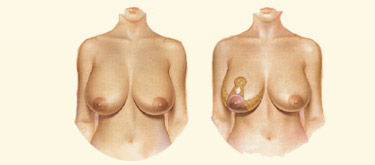
Incisions are made horizontally and vertically following the natural contour of the breast. The vertical incision creates a keyhole-shaped pattern around the areola to allow the nipple to be repositioned. Excess tissue, fat and skin are removed from the sides of the breast and around the areola. Then the nipple, areola and underlying tissue are moved to a new, higher location. If the breasts are extremely large, the surgeon may completely detach the nipple before it is relocated.
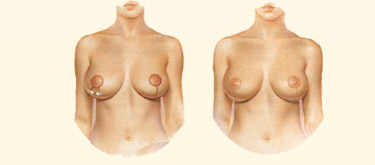
When the nipple is repositioned, skin on both sides of the breast is moved down and around the areola and brought together to reform the breast. The incision will be closed with stitches under the breast and around the nipple.
Male Breast Reduction
Gynecomastia, or male breast reduction, is the surgical removal of excess breast tissue in men. This is usually done through direct excision of the tissue, but can sometimes be performed using liposuction. The incision for this is usually made on the underside of the areola. The procedure is performed in our surgical facility under general anesthesia or local anesthesia with sedation. The type of anesthesia needed and the approach of surgery is determined at the time of your consultation. Recovery from this procedure is one to two weeks and minor swelling may last for several months. A bandage is kept in place for one week and a compression vest is usually worn. This helps to diminish swelling.